A brush isn't everything. The right brush is.
Slicker, rake, comb, soft brush... the shelf is full and the names all sound alike. In reality there are only 6 families of tools, and the choice comes down to one thing: your dog's coat. Here is which one to pick, and how to use it.
⚡ In 20 seconds
✅ Smooth coat (boxer, doberman) → rubber brush or grooming glove + soft brush
✅ Short coat + undercoat (Labrador, German Shepherd) → slicker brush, + rake during shedding
✅ Long coat + undercoat (Collie, Spitz, Golden) → detangling comb + slicker + soft brush
✅ Long silky coat (Yorkshire, Bichon) → comb + pneumatic brush, never a slicker
✅ Wiry coat (Westie, Fox Terrier) → comb + slicker, 1 to 2 times a week
First: what kind of coat does your dog have?
A coat has two layers. The topcoat (the guard hairs, smooth and waterproof) and, in many breeds, the undercoat (fine, woolly, keeps the dog warm... and tangles). It is the undercoat that sheds in spring and autumn, and that covers your sofa.
Two questions are enough:
1. Does it have an undercoat? Run your hand against the lie of the coat: a fluffy layer underneath? → yes.
2. Is the coat short, long, wiry or silky?
The chart below does the rest.
The 6 families of brushes, explained simply
The slicker brush Fine, curved metal pins. The no. 1 tool against dead undercoat and the start of tangles. Soft-pin version for sensitive skin and puppies. Avoid on long silky coats: it breaks the hair. |
The rake / the blade Widely spaced metal teeth, or a fine blade (Furminator type). They remove undercoat in bulk during shedding. On a dry, tangle-free coat, use long strokes without pressing. 1 to 2 times a week during shedding, no more. |
The detangling comb Metal, wide teeth on one side, fine on the other. Always start with it on a long coat: it finds the tangles behind the ears, under the armpits and on the hindquarters. |
The pneumatic brush Round-tipped pins on an air cushion that absorbs the pressure. The brush for long, silky coats: it detangles deeply without pulling or breaking. Gentle on the belly and paws. |
The soft / double brush Natural bristles (boar) or soft nylon. The finishing touch: it polishes, spreads the sebum and makes the coat shine. The double brush has pins on one side and bristles on the other: detangle, then polish. |
The rubber brush / the glove Soft rubber pins. For smooth coats: they lift off dead hair, massage the skin, and dogs love them. The glove also works at shampoo time. Zero risk of scratching. |
The chart to remember: coat → brushes → frequency
| Coat type (examples) | Your tools, in order | Frequency |
|---|---|---|
| Smooth boxer, pinscher, doberman, Dalmatian | Rubber brush or glove → soft brush | 1 to 2 times/week |
| Short with undercoat Labrador, German Shepherd, Husky | Slicker brush (with the lie of the coat, then against it) → fine comb for belly/paws → rake during shedding | 2 to 3 times/week, more during shedding |
| Long with undercoat Collie, Spitz, Samoyed, Golden Retriever | Detangling comb → slicker brush → soft brush to polish | Every 2 days, daily during shedding |
| Medium-long silky Cocker, Cavalier King Charles, Setter | Detangling comb → pneumatic brush → soft brush | Every 2 days |
| Long silky, no undercoat Yorkshire, Maltese, Shih Tzu | Comb (tip → root) → pneumatic brush → soft brush. No slicker. | Daily or every 2 days |
| Wiry Westie, Fox Terrier, Scottish Terrier, wire-haired Dachshund | Comb → slicker brush (dead hair does not fall out by itself) → soft brush. Hand-stripping at the groomer 2-3 times/year. | 1 to 2 times/week |
| Curly / frizzy Poodle, Bichon Frise, doodles | Detangling comb → slicker or pin brush, lock by lock. Regular clipping. | Every 2 days, grooming every 6-8 weeks |
Based on Zolux (« Comment choisir la meilleure brosse pour mon chien ? », 2025) and Francodex (« Entretenir le poil de son chien », 2025). Corded coats (Komondor, Puli) are not brushed: the cords are separated by hand.
☼ The AnimalParadise tip
The duo that works for 80% of dogs: one detangling comb + one slicker brush. The comb finds the tangles, the slicker removes the dead hair. Add a soft brush for shine, and a rake only if your dog has a real undercoat that sheds.
The right technique in 5 steps
1. Always on a dry coat. A wet tangle tightens. Brush before the bath.
2. With the lie of the coat for the top; against it only with the slicker, to reach the undercoat.
3. A tangle? Hold the base between two fingers so you don't pull the skin, and work from the tip towards the root. A hard mat: round-tipped scissors or a groomer, never force.
4. The areas that mat first: behind the ears, armpits, inner thighs, under the collar, the tail.
5. Short and positive. 5 minutes, a treat, and stop before your dog has had enough. A puppy used to it early will be an easy adult.
Our brushes, family by family
A selection from our range. Everything else (sizes S/M/L, retractable versions) is in the dog brushes section.
Slicker brushes — dead undercoat | |
 Anah slicker brush |
 Soft-pin slicker |
 Flexible double slicker |
 Retractable slicker |
Rakes and blade — shedding | |
 Double-row rake, 39 teeth |
 Anah Super Brush (stainless blade) |
Detangling combs — tangles | |
 Detangling comb 18 cm |
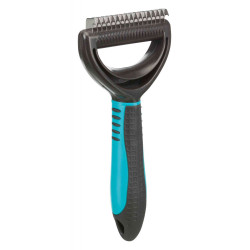 Wide detangling comb |
Pneumatic brushes — long, silky coats | |
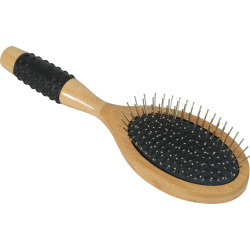 Zolux pneumatic 24.5 cm |
 Anah pneumatic |
Soft and double brushes — shine | |
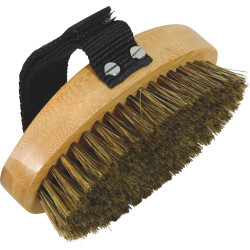 Zolux soft brush |
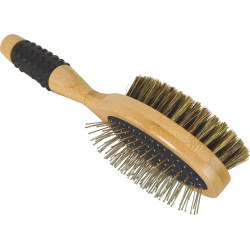 Zolux double brush |
Rubber and glove — smooth coats, puppies, bath time | |
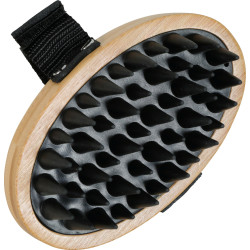 Zolux rubber brush |
 Grooming glove |
For the puppy | |
 3-piece puppy kit |
 Soft pins XS puppy |
☞ See also: dog combs · gloves and rollers · all dog grooming
Questions we are often asked
He sheds everywhere, which brush should I use?
If he has an undercoat: slicker brush 2-3 times a week, plus a rake or a Super Brush during shedding. Without undercoat (smooth coat): rubber brush, which lifts off what was about to land on the sofa.
Can one brush do everything?
For a short coat with undercoat, yes: the slicker. For a long coat, no: you need a comb and a brush. The double brush (pins + bristles) is the best "one tool" compromise.
The slicker scratches my dog, what should I do?
You are pressing too hard, or the model is too stiff. Switch to soft pins, brush small areas at a time without pressing, and never against the lie of the coat on a coat without undercoat.
From what age can I brush a puppy?
From the day it arrives (8-10 weeks), for 2 minutes, with a soft brush or glove and a treat. The aim isn't to remove hair, it's for the puppy to enjoy it.
Does a cat brush work on a dog?
The tools are the same, only the size changes. A small dog can use a "cat" slicker. Our cat guide: Which brush for my cat?
Sources
Zolux — « Comment choisir la meilleure brosse pour mon chien ? » (expert advice, March 2025) · Zolux — « Bien entretenir le pelage de son chien ou de son chat » (2023) · Francodex — « Comment entretenir le poil de son chien ? » (veterinary advice, February 2025) · Anah, Zolux and Trixie product sheets from our range.
Information provided for educational purposes. In case of tight tangles, irritated skin or abnormal hair loss, consult a groomer or your veterinarian.