
“Flea collar”: two words, two families of products that have nothing in common.
One keeps parasites away, the other kills them. Pick the wrong one and you've paid for a collar that does nothing — or worse, let an infestation take hold. Here's how to tell them apart in 2 minutes, and which one to choose for your dog.
⚡ In 20 seconds
✅ Healthy dog, no fleas: a repellent collar is enough — it keeps fleas, ticks, mosquitoes and sandflies away for 4 months
✅ Dog already infested: you need an insecticide (veterinary collar, spot-on or tablet) and you need to treat the house
✅ Sandfly area (southern France, leishmaniasis): ask for a veterinary deltamethrin collar
✅ In every case: check the minimum age and weight, and never use a “dog” product on the household cat
❔ Repellent or insecticide: the difference in one table
| Repellent collar | Insecticide / acaricide collar | |
|---|---|---|
| What it does | Keeps parasites away: it scrambles their sense of smell and irritates them on contact. Does not kill. | Kills the fleas and ticks already present, then protects against new ones. |
| Status | Biocide (PT19). Sold freely in pet shops. | Veterinary medicine (marketing authorisation). Pharmacy, vet, or pet shop for some products. |
| Active substances | Icaridin, geraniol, margosa, lavandin, eucalyptus citriodora… | Deltamethrin, dimpylate, imidacloprid + flumethrin, permethrin… |
| When to use it | For prevention, on a healthy dog, throughout the warm season. | Dog already infested, heavy parasite pressure, high-risk areas (ticks, sandflies). |
| Duration | 4 months (fleas, ticks, flies) · 3 months (mosquitoes, sandflies) — Francodex | 5 to 8 months depending on the product (e.g. deltamethrin: 6 months for ticks, 5 months for sandflies) |
| Minimum age | Puppies from 4 months (Francodex) | Varies, often 7 weeks to 3 months — read the leaflet |
| Limitations | Won't solve an ongoing infestation. Less effective under very heavy pressure. | Active molecules: precautions needed (children, household cats, swimming); a prescription or professional advice is sometimes required. |
☞ How does a repellent collar work?
It continuously releases small amounts of active ingredients from its matrix, which spread through the natural oils of the skin. Two modes of action, according to Francodex:
✔ The scent decoy. Icaridin — the molecule recommended by the Institut Pasteur for human repellents — sends a false signal to the sensory receptors of fleas, ticks and mosquitoes: as far as they're concerned, your dog “no longer exists”.
✔ The irritant effect. Geraniol, lavandin, margosa: any parasites that do touch the coat are irritated and driven off.
The result: immediate action as soon as it's fitted, no PVC or phthalates, water-resistant, with a breakaway safety system that opens if the collar gets caught. It's the right choice for a healthy dog and an owner who doesn't want to handle a spot-on pipette every month.
✘ When a repellent isn't enough
Let's be clear: if you can see fleas on your dog, a repellent collar on its own won't fix anything. Francodex says so on its own leaflets: “this product is not a medicine; if the infestation persists, consult a veterinarian”.
Why? Because the fleas you can see are only 5% of the problem. The other 95% — eggs, larvae, pupae — are in your carpets, skirting boards, dog beds and sofas (ESCCAP, the European network of veterinary parasitologists). A single female lays 20 eggs a day, and they all drop to the floor.
The protocol that works, according to ESCCAP:
1️⃣ A veterinary insecticide on the dog (collar, spot-on or tablet) to kill the adults.
2️⃣ Treat every animal in the household, not just the one that's scratching.
3️⃣ Treat the environment: vacuum thoroughly (and bin the bag), wash textiles at 60 °C, use a household spray.
4️⃣ Repeat the treatment: “many treatment failures are simply down to not repeating the treatment” (ESCCAP).
5️⃣ Once the house is clear: the repellent collar takes over again, to prevent re-infestation.
⚠️ The special case of sandflies and leishmaniasis
In the south of France and the Mediterranean basin, the sandfly (a tiny biting midge active from dusk to dawn, April to October) transmits leishmaniasis, a serious disease with no definitive cure in dogs. There, preventing bites is vital.
Francodex icaridin repellent collars keep sandflies away for 3 months. For maximum protection in high-pressure areas, vets recommend 4% deltamethrin collars (such as Prevendog or Scalibor): 5 months against sandflies, 6 months against ticks, suitable from 7 weeks of age. These are veterinary medicines: ask for advice.
☛ Our repellent collars for dogs
Two Francodex formulas, made in France, free from PVC and phthalates, 4 months of protection, breakaway safety system. Choose according to your dog's weight and neck size.
Icaridin formula — the most complete: fleas, ticks, flies for 4 months · mosquitoes, sandflies for 3 months
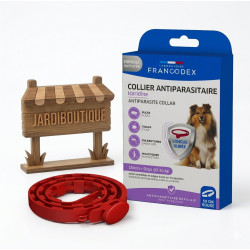
Icaridin 50 cm red |
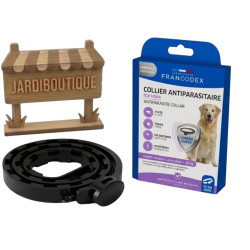
Icaridin 70 cm black |
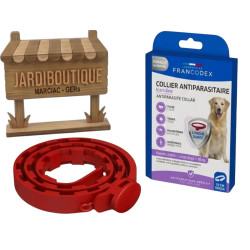
Icaridin 70 cm red |

Icaridin 60 cm black |
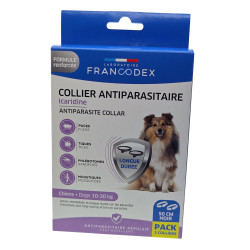
Pack of 2 · 50 cm |
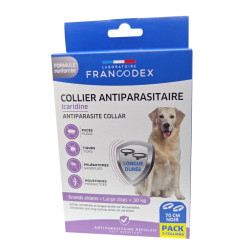
Pack of 2 · 70 cm |
Geraniol · margosa · lavandin formula — the plant-based repellent, gentle on the wallet, from 4 months of age
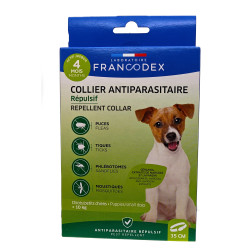
Repellent 35 cm |
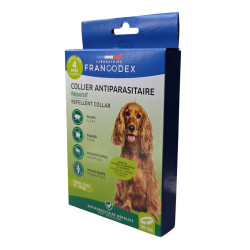
Repellent 50 cm |
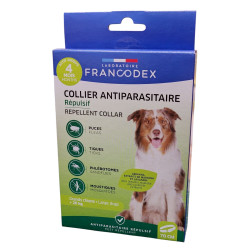
Repellent 70 cm |
☞ The whole range: dog care and parasite control
☑ Fitting and using your collar properly
✅ Two fingers between the collar and the neck, no more, no less: too loose and it won't diffuse, too tight and it will hurt. Trim off the excess.
✅ Write down the fitting date and replace it after 4 months — or sooner if you see parasites again (Francodex).
✅ It's water-resistant, but take it off for long baths and repeated swims: it will last longer.
✅ Never use it to tie up or lead your dog: the breakaway safety system is designed to open.
✅ Wash your hands after fitting, keep out of reach of children, and never discard it outdoors.
⚠️ A cat in the house? Read this
Some insecticide collars and spot-ons for dogs contain permethrin, which is lethal to cats, as they are unable to break it down. The French health agency ANSES recorded 122 reports of poisoning, including 54 serious cases and 6 cat deaths, linked to “dog” parasite treatments (Vigil'Anses, 2019). Cats are exposed by licking a treated dog within the first 48 hours. If your dog is wearing a permethrin product, keep them apart for two days. The Francodex repellent collars shown here contain none.
☞ For your cat, read our dedicated guide: Flea collars for cats: how to choose a safe one.
❓ The questions we get asked
⏱️ How long does the collar take to work?
Immediately for a Francodex repellent (it acts as soon as it's fitted). Still allow 24 to 48 hours for the active ingredients to spread across the whole coat.
▪ Repellent collar + insecticide spot-on: can they be combined?
Yes, and it's actually the standard approach during an infestation: the spot-on kills, the collar stops them coming back. Just make sure the spot-on isn't permethrin-based if there's a cat at home.
▪ My puppy is 3 months old, which collar should I choose?
None of these: Francodex repellents are for puppies aged 4 months and over. Before that, ask your vet (some insecticides are approved from 7-8 weeks).
▪ Why does my dog still get ticks with a collar on?
A repellent greatly reduces the number of ticks that attach, but it doesn't eliminate them 100%, especially in woodland or at peak season (spring, autumn). Check your dog after every walk and remove ticks with a tick hook. In heavily infested areas, switch to a veterinary acaricide.
▪ Which length should I choose?
Measure the neck and add 5 cm for the buckle and the excess. The weight guides given (under 10 kg / 10-20 / 10-30 / over 20-30 kg) are enough in most cases.
✎ Sources
Laboratoire Francodex — technical data sheets for icaridin flea and tick collars (ref. 176028-176033) and geraniol/margosa/lavandin repellent collars (ref. 175472-175474): composition, duration, minimum age, precautions; news item « Colliers et pipettes antiparasitaires répulsifs à l'icaridine » (2023); news item « Colliers Prevendog » (2024) · ESCCAP France — « Les puces : chien, chat, furet… » (life cycle, 95% of the population in the environment, treatment recommendations) · ANSES — Vigil'Anses no. 8, June 2019, « Intoxications des chats à la perméthrine » · Regulation (EU) No 528/2012 (biocidal products, product type 19: repellents).
This information is provided for educational purposes. It does not replace the advice of your veterinarian, who alone is qualified to prescribe a medicinal parasite treatment or to diagnose an infestation, dermatitis or vector-borne disease.