
A cat is not a small dog. Its liver cannot break down certain molecules, it grooms itself all day long and it climbs everywhere with its collar on. Choosing a flea collar for a cat means, first of all, choosing what you spare it. Here is the difference between repellent and insecticide, what is safe, what is banned, and our collars.
⚡ In 20 seconds
✅ Healthy cat, for prevention: a repellent collar designed for cats, with a safety release system — 4 months of peace of mind
✅ Cat already infested: a veterinary insecticide for cats + treatment of the home, the repellent collar comes afterwards
✅ Never use a dog product on a cat: permethrin kills cats
✅ Kitten: not before 4 months for Francodex repellents, and a minimum weight (1 kg kitten, 2 kg cat)
❔ Repellent or insecticide: the difference in one table
| Repellent collar | Insecticide / acaricide collar | |
|---|---|---|
| What it does | Keeps away fleas, ticks, mosquitoes and sandflies: scent decoy + irritant effect on contact. Does not kill. | Kills the fleas and ticks present, then protects against new ones. |
| Status | Biocide (PT19), freely sold in pet shops. | Veterinary medicine (marketing authorisation): pharmacy, vet, sometimes pet shop. |
| Substances | Icaridin, lavender oil, eucalyptus citriodora, geraniol, margosa, lavandin. | Imidacloprid + flumethrin, dimpylate… Permethrin: banned for cats. |
| When | For prevention, healthy cat, all through the warm season (and all year round for an indoor cat in a heated home: fleas never sleep). | Cat already infested, heavy pressure, outdoor cat in a tick area. |
| Duration | Up to 4 months (Francodex) | Up to 7-8 months depending on the product |
| Minimum age / weight | 4 months; 1 kg (kitten) or 2 kg (cat) — Francodex | Often 10 weeks — read the leaflet |
| Limits | Does not treat an ongoing infestation. | Active molecule released continuously on an animal that grooms itself: follow the leaflet strictly. |
⚠️ Rule no. 1: never a "dog" product on a cat
This is not a precaution on principle, it is a documented cause of death. Permethrin, found in many insecticide collars, pipettes and sprays for dogs, is not eliminated by the cat's liver (glucuronidation deficiency). The result: tremors, seizures, death.
The figures from the French health agency ANSES (Vigil'Anses, 2019): 122 reports of permethrin poisoning, 54 considered serious, 6 cats dead, all linked to parasite treatments authorised… for dogs. A single "dog" pipette is enough to kill a 5 kg cat. And the cat does not even need to be treated: it only has to lick the family dog within 48 hours of application.
So: a collar labelled for cats, always. The Francodex repellent collars below are formulated for cats and contain no permethrin.
☞ How does a repellent collar for cats work?
The collar slowly releases its active ingredients into the sebum of the coat, without passing them into the bloodstream. Francodex combines two effects:
✔ The scent decoy — icaridin (the molecule recommended by the Institut Pasteur for human repellents) confuses the receptors of fleas, ticks and mosquitoes.
✔ The irritant effect — lavender oil, eucalyptus citriodora, or geraniol/margosa/lavandin depending on the formula: a parasite that touches the coat is irritated and leaves.
Immediate action once fitted, up to 4 months of protection, PVC- and phthalate-free, water-resistant. And above all, for a cat: the safety release system, which opens the collar if it gets caught on a branch or a fence. Never choose a flea collar without this system for a cat that goes outside.
✘ When a repellent is not enough
A cat that already has fleas will not get rid of them with a repellent collar. Francodex says so on its leaflets: "this product is not a medicine, if the infestation persists consult a veterinarian".
The reason is the same as for dogs: the visible fleas are 5% of the problem; eggs, larvae and pupae — 95% — live in your carpets, skirting boards, sofas and beds (ESCCAP). And the cat, which grooms constantly, swallows some of the fleas: that is also how it catches tapeworm.
The protocol recommended by ESCCAP:
1️⃣ A veterinary insecticide for cats (pipette, tablet or acaricide collar) — ask your vet, especially for a kitten or an elderly cat.
2️⃣ Treat all the animals in the household at the same time.
3️⃣ The environment: vacuum everywhere (throw away the bag), wash bedding at 60 °C, household spray.
4️⃣ Repeat according to the leaflet: most failures come from a treatment done only once.
5️⃣ Then the repellent collar takes over to prevent re-infestation.
☛ Our repellent collars for cats and kittens
Francodex, made in France, PVC- and phthalate-free, safety release system, from 4 months of age. Single length 35 cm, to be cut to size.
Icaridin formula — fleas, ticks, mosquitoes and sandflies, up to 4 months
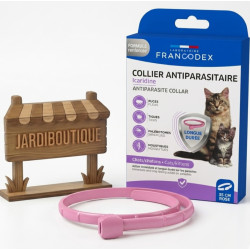
Icaridin pink |
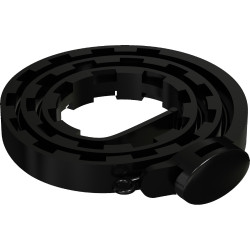
Icaridin black |
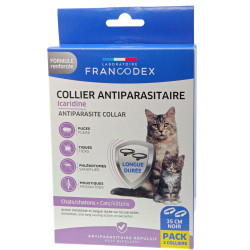
Pack of 2, black |
Geraniol · margosa · lavandin formula — the plant-based repellent, at a gentle price
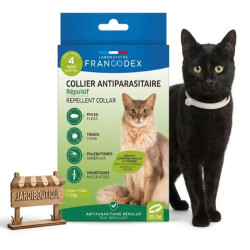
Cat repellent |
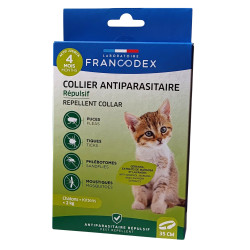
Kitten repellent |
Unsure about weight or age? Write to us before ordering, we will point you in the right direction. |
☞ The whole department: care and anti-parasite products for cats
☑ Fitting and using your collar properly
✅ Two fingers between the collar and the neck. Cut off the excess, otherwise the cat will chew it.
✅ Keep an eye on things during the first few days: redness or broken hairs under the collar = remove it and rinse. Essential oils can cause a reaction in a few cats (Francodex points this out for lavender oil).
✅ Note the date and replace after 4 months, or sooner if you see parasites again.
✅ Never for tethering, never with a heavy ID tube that makes it spin round.
✅ Wash your hands after fitting; keep out of reach of children; do not discard in the environment.
❓ The questions we are asked
▪ My cat does not go outside, does it need a collar?
Less than an outdoor cat, but fleas come in on your shoes, with the dog, or with another cat. A heated flat lets them breed all year round. For light prevention, a geraniol repellent is more than enough.
▪ My kitten is 8 weeks old, which collar?
None of these: Francodex repellents are for 4 months and 1 kg upwards. Before that, only your vet can offer a suitable product. A daily fine comb, on the other hand, is risk-free.
▪ Collar or pipette?
The collar: 4 months without thinking about it, ideal for a cat that will not let itself be handled. The pipette: to be redone every month, but dosed by weight and nothing around the neck. Many owners combine both: an insecticide pipette when needed, a repellent collar the rest of the time.
▪ My cat is still scratching with the collar on, why?
Three possibilities: an infestation that has already set in (the repellent does not kill → insecticide + home protocol), an allergy to flea bites (a single bite is enough to trigger the itching), or irritation caused by the collar itself. If in doubt, remove it for 48 hours and observe.
▪ And for my dog?
Read our guide: Anti-parasite collar for dogs: repellent or insecticide?
✎ Sources
Laboratoire Francodex — technical data sheets for icaridin anti-parasite collars for cats (ref. 176026, 176031) and cat/kitten repellents (ref. 175470, 175471): composition, duration, minimum age and weight, precautions; news item « Colliers et pipettes antiparasitaires répulsifs à l'icaridine » (2023) · ANSES (French health agency) — Vigil'Anses no. 8, June 2019, « Intoxications des chats à la perméthrine » (122 reports, 54 serious, 6 deaths) · ESCCAP France — « Les puces : chien, chat, furet… » (95% of the population in the environment, treatment of animals and the home, repeat treatment) · Regulation (EU) No 528/2012 (biocides, PT19).
Information provided for educational purposes. It does not replace the advice of your veterinarian, who alone is qualified to prescribe a medicinal anti-parasite treatment or to diagnose an infestation, an allergy or poisoning.