
Are your hens laying less, with a pale comb, and refusing to go to roost at night?
Red mite is often the culprit. This tiny mite lives hidden in the hen house and only climbs onto the birds at night to feed on their blood. That is why it has to be treated on two fronts, the bird and its shelter, over several weeks. Here is the method, without jargon.
⚡ In 20 seconds
✔ It is not a true louse: it is a mite (Dermanyssus gallinae) that hides in the cracks of the coop by day and bites at night.
✔ Treating the hens alone is not enough: most of the population lives in the wood, the perches and the nest boxes.
✔ The right rhythm: a thorough clean, then treat both hens and coop, repeated 3 times about 7 days apart to break the cycle.
✔ It can be done without chemical insecticide: dimethicone on the hens, diatomaceous earth in the coop.
How do you know if your hens have red mites?
The poultry red mite is 0.7 to 1 mm long. Unfed it is grey-white; it turns dark red once full of blood, hence its name. It spends the day hidden in the crevices of the coop (under perches, plank joints, nest boxes, bedding) and comes out at night to bite the birds.
Because it is rarely seen on the hens in daylight, an infestation often goes unnoticed until the birds show signs of tiredness.
Warning signs
- Pale comb and wattles (a sign of anaemia), tired, less active hens.
- Drop in egg laying.
- Hens that refuse to enter the coop or go up to roost in the evening.
- Damaged feathers, feather pecking, itching.
- A grey dust (mite droppings) under the perches and in the corners.
The evening test, in 2 minutes
An hour after nightfall, take a torch and wipe a white tissue or paper under the perches and along the joints. Red streaks when you squash them = blood-fed red mites. Another method: slip a piece of corrugated cardboard or a split tube under a perch for a few days, then shake it over a white sheet: the mites take refuge in it.
Why a single treatment never works
The red mite goes through 5 stages: egg, larva, two nymph stages and adult. A female can lay up to 300 eggs during her life. Above all, its full cycle is very fast when it is warm:
| Temperature in the coop | Length of full cycle (egg → adult) |
|---|---|
| 25 to 30 °C (summer) | 7 to 10 days |
| 20 °C | 14 to 17 days |
| 15 °C | about 28 days |
| Below 9 °C | Development stops (but the mites survive) |
Two practical consequences: (1) a product applied today does not reach the eggs that will hatch in a few days, so you must repeat the treatment about 7 days apart, at least 3 times; (2) an adult can survive several months without a blood meal (up to 9 months according to some sources): a coop that has stood empty is not necessarily clean.
Which product for what? The decision table
Combine a product on the hens (to remove the mites on the bird) with a product in the coop (where most of the population lives). Drinking-water products and repellents are then used to space out re-infestations.
| Product | Where and how | How it works | Frequency |
|---|---|---|---|
| Dimethicone spray 750 ml | On the plumage, from 10 cm, until the feathers are slightly damp | Mechanical action: dimethicone traps the mite, which can no longer move. No chemical insecticide | Every 10 days if needed |
| Ecto Choc Parasites Duo 750 ml | On the birds and in the coop (perches, corners, bedding) | Liquid film that blocks the parasite. Plant-based ingredients (except water) | Depending on infestation, following the label |
| Diatomaceous earth aerosol 750 ml | In cracks, corners, under perches; keep animals and people out for 2 h | Mineral powder that dries out the mites' cuticle. No resistance | As long as the powder is visible; renew after cleaning |
| Diatomaceous earth 2.5 kg | Dusted in the coop, nest boxes and bedding | Same drying action as the aerosol, for large areas | At every bedding change |
| Pyrethrum Habitat powder 500 g | On walkways, floor and wall crevices: 25 g/m² | Plant-based insecticide (pyrethrum) acting on the nervous system of insects and mites | After each cleaning, or after rain outdoors |
| Pounet 1 L | In drinking water: 5 ml per litre | Thyme and tansy extracts: gives the birds a smell that repels red mites | 7 days in a row, then 2 days every 15 days |
| Repellent pipettes for hens, geese, ducks | At the base of the neck: 1 pipette (0.4 ml) per bird under 4 kg, 2 above | Repellent based on margosa and geraniol | Every 4 weeks |
| Repellent powder 900 g | All over the body, parting the feathers, also in the coop | Repellent based on margosa and geraniol | Once a month; once a week for heavy infestation |
☼ AnimalParadise tip
If you only buy two products, choose a dimethicone spray for the hens and diatomaceous earth for the coop. Both work mechanically: mites do not become resistant, and there is no chemical insecticide in your hens' environment. Keep the repellents (Pounet, pipettes, powder) for prevention once the infestation is under control.
Step-by-step protocol over 3 weeks
Choose a dry day and start in the morning, when the mites are hiding in the shelter.
Day 0 — Deep clean
Take the hens out. Remove all bedding, droppings and feathers, scrape the perches and nest boxes, take apart what you can and burn or bag the used bedding. Clean with hot water and let it dry: a dry, airy coop is the red mite's worst enemy.
Day 0 — Treat the shelter
Once dry, treat all cracks, joints and the underside of perches (Diatomaceous earth aerosol 750 ml or Pyrethrum Habitat powder 500 g), then lay clean bedding dusted with Diatomaceous earth 2.5 kg.
Day 0 — Treat the hens
In the evening or the next day, treat each hen with Dimethicone spray 750 ml, especially under the wings, around the vent and on the neck.
Day 7 and day 14 — Repeat
Repeat the treatment of shelter and hens to reach the mites that have hatched in the meantime. In summer (7 to 10-day cycle), do not skip a step.
Afterwards — Prevention
Do the evening test once a week during the warm season. Maintain with diatomaceous earth at each bedding change and, if needed, a repellent (Pounet 1 L or Repellent pipettes for hens, geese, ducks).
Eggs and consumption: always follow the precautions on each product's label. Mechanical-action products (dimethicone, diatomaceous earth) contain no chemical insecticide; if in doubt about a specific product, ask your vet.
Our products against red mites
All the products below are in stock in our Poultry > Treatment section.
On the hens

Dimethicone spray 750 ml |
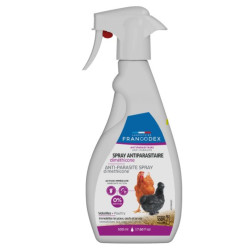
Dimethicone spray 500 ml |

Ecto Choc Parasites Duo 750 ml |
In the coop
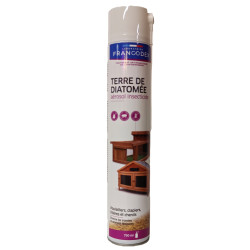
Diatomaceous earth aerosol 750 ml |
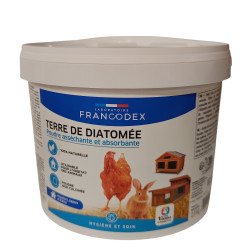
Diatomaceous earth 2.5 kg |

Diatomaceous earth 450 g |
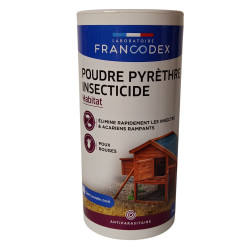
Pyrethrum Habitat powder 500 g |
Prevention

Pounet 1 L |
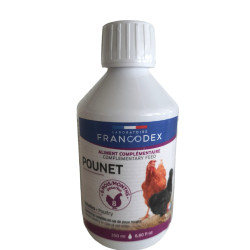
Pounet 250 ml |

Repellent pipettes x4 |
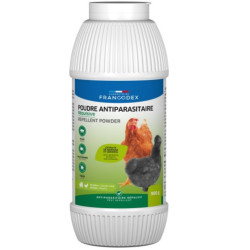
Repellent powder 900 g |
See the whole poultry treatment section
Red mite, grey louse or scaly leg? Don't confuse them
| Parasite | Where it lives | What you see | What to do |
|---|---|---|---|
| Red mite (Dermanyssus mite) | In the coop by day, on the hen at night | Anaemia, pale comb, fewer eggs, grey dust under perches | Treat hens and shelter, 3 times 7 days apart |
| Grey louse (true louse) | Permanently on the hen, in the feathers | Small beige insects near the skin, eggs stuck to the base of the feathers | Mainly treat the hens (Dimethicone spray 750 ml, Repellent powder 900 g) |
| Scaly leg (mite) | Under the leg scales | Raised scales, whitish crusts, thickened legs | Gal O Cade 200 ml on the legs, Gal O Pat (bedding) in the bedding |
If in doubt, or if a hen loses weight, stays listless or does not improve after the 3 treatments, see a vet: severe anaemia can be serious.
Preventing red mites from coming back
- A dry, airy and bright coop with as few cracks as possible (fill the joints, prefer smooth removable perches).
- Bedding changed regularly, mixed with diatomaceous earth.
- Quarantine for any new hen, and check second-hand equipment (crates, nest boxes).
- The evening test every week from spring to autumn: the earlier you act, the easier it is.
Frequently asked questions
▪ Do red mites bite humans?
They can occasionally bite humans and cause itching (dermatitis), but they do not live on people. Wear gloves and long sleeves to clean an infested coop.
▪ How long does it take to get rid of them?
Allow at least 3 weeks of treatment (day 0, day 7, day 14), then regular monitoring. An old infestation may need more rounds.
▪ Why do red mites come back after treatment?
Because eggs are not reached by a single treatment and adults hidden in the shelter survive for months without feeding. Hence repeated treatment and a full clean of the coop.
▪ Is diatomaceous earth enough on its own?
It is very useful in the coop, but it only works where it is applied and as long as it stays dry. Combine it with a treatment of the hens during the attack phase.
▪ Does cold kill red mites?
No. Below 9 °C their development stops, but they survive and start again as soon as it warms up. That is why you deep-clean at the end of winter.
▪ Can I treat chicks or broody hens?
Read each product's label: authorised ages and uses are stated there. For a broody hen, treat the nest and shelter rather than the bird, and ask your vet if in doubt.
✎ Sources
Laboratoire Francodex — product sheets: dimethicone pest control spray (dimethicone 38 g/l, aloe vera 5 g/l, renew every 10 days), Ecto Choc Parasites Duo, diatomaceous earth (aerosol and powder), Pyrethrum Habitat powder (25 g/m²), Pounet (thyme and tansy), repellent pipettes and powder (margosa and geraniol); WikiVet (fr.wikivet.net) — Dermanyssus gallinae: stages, lifestyle, survival, clinical signs, risk to humans; Diatosphère — red mite life cycle by temperature and survival up to 9 months; Animalis — detection advice and coop cleaning protocol.
This guide is for information only and does not replace a vet's advice. Always follow the instructions and precautions on each product's label.