
Your cat grooms itself. So why brush it?
Because everything it removes with its tongue, it swallows: that's where hairballs come from. Because a long-haired cat can't untangle itself. And because half the hair on your sweater could have ended up in the brush. Here is the right brush for each coat — and above all, the one your cat will accept.
⚡ In 20 seconds
✅ Short coat (European, Siamese, Bengal) → glove or rubber brush, 1 to 2 times a week
✅ Medium coat (Maine Coon, Birman, Ragdoll) → detangling comb + small slicker, every 2 days
✅ Long coat (Persian, Angora) → comb every day, soft slicker, groomer if there are knots
✅ Sheds a lot → de-shedding blade once a week during the moult, no more
✅ Hates it → start with the glove, 1 minute, on the back only
A cat is not a small dog
Three differences that change the choice of brush:
Its skin is thinner and more mobile. A slicker with hard pins, used as you would on a Labrador, irritates it. Choose soft and small, and never press down.
It swallows its dead hair. When licking itself, it ingests everything that comes loose → regurgitated hairballs, sometimes constipation. Every brushing session means that much less hair going through the stomach.
It decides. A cat that is forced will never let itself be brushed again. Short sessions, a calm moment, and stop before it walks away.
The 5 tools that really work
The glove / rubber brush To start with, and for all short coats. Soft nubs that stroke, massage and catch dead hair. The tool cats accept first: it feels like a hand. |
The comb (detangling + fine) The essential for medium and long coats. Wide teeth to find knots (armpits, belly, britches, ears), fine teeth to smooth. Always first, before any brush. |
The small soft slicker For the undercoat of medium and long coats. Fine, flexible pins, cat size, ideally retractable. After the comb, never instead of it. Light, without pressing. |
The blade (Furminator) For cats that shed a lot. A stainless steel blade that catches the dead undercoat. Spectacular, but once a week at most, on dry, detangled hair: too often, and it thins the living coat. |
The flea comb Not for brushing: for checking. Very tight teeth that catch fleas and droppings (black grains that turn red on damp paper). Once a week, base of the tail and neck. If you find any: see our guide flea collar for cats. |
|
The chart to remember: coat → tools → frequency
| Coat type (examples) | Your tools, in order | Frequency |
|---|---|---|
| Short European, Siamese, Bengal, Chartreux | Glove or rubber brush → soft brush to add shine | 1 to 2 times a week · 3 during the moult |
| Short, dense undercoat British Shorthair, Chartreux, Exotic | Rubber brush → small soft slicker → blade during the moult | 2 times a week |
| Medium Maine Coon, Birman, Ragdoll, Norwegian Forest | Detangling comb (armpits, belly, britches) → soft slicker → fine comb | Every 2 days · daily during the moult |
| Long Persian, Angora, Himalayan | Comb (tip → root) → soft slicker → fine comb. Mats: round-tipped scissors or groomer. | Every day, 5 min |
| Kitten, senior cat, fearful cat | Glove or soft brush only, back and sides. You get it used to it, you don't detangle. | Often and very short |
Indicative frequencies based on Zolux (“Bien entretenir le pelage de son chien ou de son chat”) and the recommendations of cat groomers. A cat living in a heated apartment sheds a little all year round.
☼ The AnimalParadise tip
Start always with the glove, even for a long-haired cat. When it purrs under the glove, move on to the comb. When it accepts the comb, the slicker. A cat that associates the brush with a pleasant moment will let you groom it for life.
The right technique in 5 steps
1. The right moment: after a meal or a nap, when it is relaxed. Never when it is playing.
2. Back and sides first, in the direction of the hair. Belly, britches and armpits last, once it is used to it — that is where tangles form, and where it hates it most.
3. A knot: hold the base between two fingers, work from the tip towards the root, in small strokes. If it resists, stop and try again tomorrow.
4. A mat stuck to the skin cannot be untangled: round-tipped scissors with a comb slid between the skin and the mat, or the groomer. Never use pointed scissors: a cat's skin cuts very easily.
5. 1 to 5 minutes, then a reward. Better 3 minutes every day than 20 minutes on Sunday.
Our brushes and combs for cats
A selection from the department. The full range is in cat brushes and cat combs.
To start with — glove, rubber, soft brush | |
 Grooming glove |
 Rubber brush 8 × 13 cm |
 Soft brush |
 Universal cat brush |
Medium and long coats — comb + slicker | |
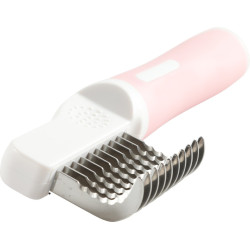 Zolux detangling comb |
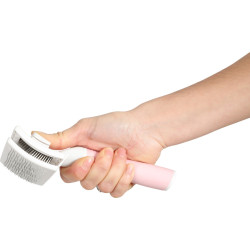 Zolux retractable slicker |
 Fine comb 40 teeth |
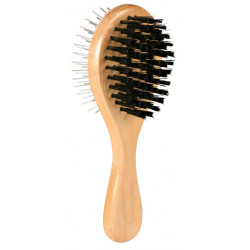 Double-sided brush 17 cm |
Sheds a lot — the Furminator blade | |
 Furminator short hair |
 Furminator long hair |
For checking — flea combs | |
 Flea comb 70 teeth |
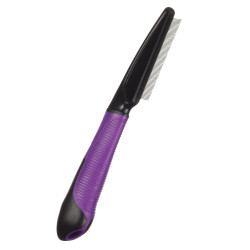 Flamingo flea comb 21 cm |
The questions we get asked
My cat throws up hairballs: is brushing enough?
It greatly reduces how often, especially during the moult. If it persists despite regular brushing, talk to your vet: there are specific pastes and foods, and repeated regurgitation can hide something else.
It bites me as soon as I take out the brush.
Put the slicker away. Glove only, 30 seconds, on the back, while it eats or purrs. Add a few seconds each day. Allow two to three weeks.
Is the Furminator every day better?
No. The blade also removes living hair if you overdo it. Once a week during the moult, less the rest of the year, never on irritated skin.
My Persian has mats on its belly: should I cut them?
Not with pointed scissors: a cat's skin is very thin and can be cut without you noticing. Slide a comb between the skin and the mat, use round-tipped scissors above it, or see the groomer. Then comb daily.
And for my dog?
The guide is here: Which brush for my dog?
Sources
Zolux — “Bien entretenir le pelage de son chien ou de son chat” (2023) · Zolux — “Comment choisir la meilleure brosse pour mon chien ?” (2025), adapted to cats · Francodex — “Comment entretenir le poil de son chien ?” (2025) · Zolux, Furminator, Flamingo and Anah product pages from the department.
Information provided for educational purposes. Frequent regurgitation, irritated skin, dull coat or patchy hair loss: consult your vet.